No One Makes You Feel Anything (And Why That's Actually Good News)
No one makes you feel anything.
Okay, wait. If you're anything like me the first time I heard that, you're already feeling something about that statement. Good. Stay with me.
Because truly getting this — not just intellectually, but actually living it — might be one of the most powerful things you can do for your relationships.
Here's how it works.
A thing happens. A behavior. A comment. A snappy retort. A dramatic sigh that says everything without actually saying anything. You know the one.
Your nervous system takes it in and starts doing what nervous systems do. Interpreting it. Assigning meaning. Making up a story about what it means, what they meant, what it says about you, about them, about the relationship.
And what you make up is what generates the feeling.
Now here's where it gets interesting. You might be right. Your interpretation might be completely accurate. Maybe that comment really was dismissive. Maybe the sigh really was passive-aggressive. Maybe you read the room perfectly.
But that's not actually the point. At least not in the way you think.

Because in that moment, you have a choice. A choice about how to respond. And when you take radical responsibility for your own interpretation and your emotional reaction, you get to make that choice from a completely different place.
That might sound like: "That didn't feel good." Or "Can we try that again?" Or "You sound upset. What's going on?" Or even "I'm not okay with where this interaction is headed."
This isn't about going quiet. It's not about letting things slide or being endlessly patient while you slowly lose your mind. It's not about accommodating behavior that isn't okay.
It's about shifting your stance in hard moments so you can walk a different path. And actually invite your partner to walk it with you, instead of both of you getting caught in the same trap you've been stuck in forever, nothing changing.
What This Actually Looks Like in a Real Argument
Let's make this concrete, because the theory is easy. The 10 PM argument is not.
Your partner comes home distracted and short with you. You say something, they barely respond. You make up: they're annoyed at me, I must have done something wrong, here we go again. You feel anxious. Maybe a little hurt. Maybe a lot.
Without radical responsibility, that plays out one of two ways. You either go cold and pull back — and now you're both distant and nobody knows why. Or you come in hot: "What's your problem tonight?" And now it's a fight about the fight before anyone's even figured out what the fight is actually about.
With radical responsibility, you notice what you made up. You own that you don't actually know what's going on with them. And instead of reacting from that story, you get curious. "Hey, you seem off. Long day?"
That's it. That's the whole move. It's simple and it is genuinely hard to do when your nervous system is already activated.
Or this one: you're in the middle of a disagreement and your partner says something that lands sideways. Your instinct is to defend yourself, correct them, explain why they're wrong about what you meant. Radical responsibility sounds like pausing and saying, "That came out wrong. Can I try that again?" Or even: "I can see why that landed the way it did."
You're not conceding the argument. You're refusing to let the argument become about something else entirely.
The common thread in all of it is the pause. The split second between what happened and how you respond. That pause is where radical responsibility lives. And the more you practice it, the more accessible it becomes — even when you're activated, even when you're sure you're right, even when it feels completely unfair that you're the one doing this.
Not All Behavior Is Equal
Radical responsibility doesn't mean all behavior gets the same response.
There's behavior that's obnoxious. The passive stuff: the sighing, the eye rolls, the comments with just enough deniability to make you feel crazy for bringing them up. This stuff won't blow up your relationship overnight. But don't underestimate it either. It's enough to slowly kill a marriage over time. You can take radical responsibility for your reaction and name it. Those two things aren't in conflict.
Then there's behavior that's genuinely dysfunctional. Patterns that have calcified, where both people are locked into cycles that aren't working and real damage is accumulating. This is where the work usually needs to go deeper, often with support.
And then there are actual boundary violations. Which are a different category entirely.
Boundary violations are things like:
Name-calling. Character assassination. Serious shaming language. Ridicule. The kind of sarcasm that isn't playful. It's mean, and everyone knows it.
Yelling and screaming. Verbal assault.
Physical blocking, restraining, or any form of physical aggression.
Serious breaches of trust: lying, manipulating, breaking agreements without accountability.
Controlling behavior. Telling someone how they should or shouldn't feel. What they should or shouldn't do. Who they're allowed to be.
These aren't situations where the work is just reframing your reaction. These are situations that call for clear limits. Full stop.

Taking responsibility for your reactions is not the same as taking responsibility for someone else's harmful behavior.
The premise still holds. You're always responsible for how you respond. But how you respond to a boundary violation might look like: "This isn't okay. I won't engage when it goes here." Or deciding what you're actually willing to tolerate. Or getting help.
Why This Changes Everything
Most couples I work with aren't navigating the severe end of this. They're in the middle. Grinding daily friction, misread cues, old wounds getting triggered, the same argument cycling through with slightly different details.
And in that space, this shift is everything.
This is actually one of the core principles I work from in Relational Life Therapy (RLT). RLT is direct. It doesn't spend a lot of time in the "but why does my partner do this" spiral. It comes back, over and over, to the one variable you can actually control: yourself. Your reactions. Your responses. The way you show up when things get hard.
That's not a limitation of the model. It's the whole point. Because the moment you stop waiting for your partner to change before you can feel differently, you're no longer stuck. You stop being at the mercy of their behavior. You become someone who can actually influence how the interaction goes. Not by controlling them. By managing yourself.
And when you do that consistently, you change the dynamic. You break your side of the cycle. You create actual room for something different to happen.
That's radical responsibility. Not a performance of patience. Not suppressing how you feel. Just the ongoing, honest commitment to own your reactions and respond with integrity, even when it's hard.
That's what changes everything.
If this is something you want to work on, I work withindividuals andcouples usingRelational Life Therapy, Brainspotting, and Accelerated Resolution Therapy. In-person in Roseville, CA and online throughout California and Texas.Reach out to schedule a free 20-minute consultation.
SIGN UP TO MY NEWSLETTER AND GET THE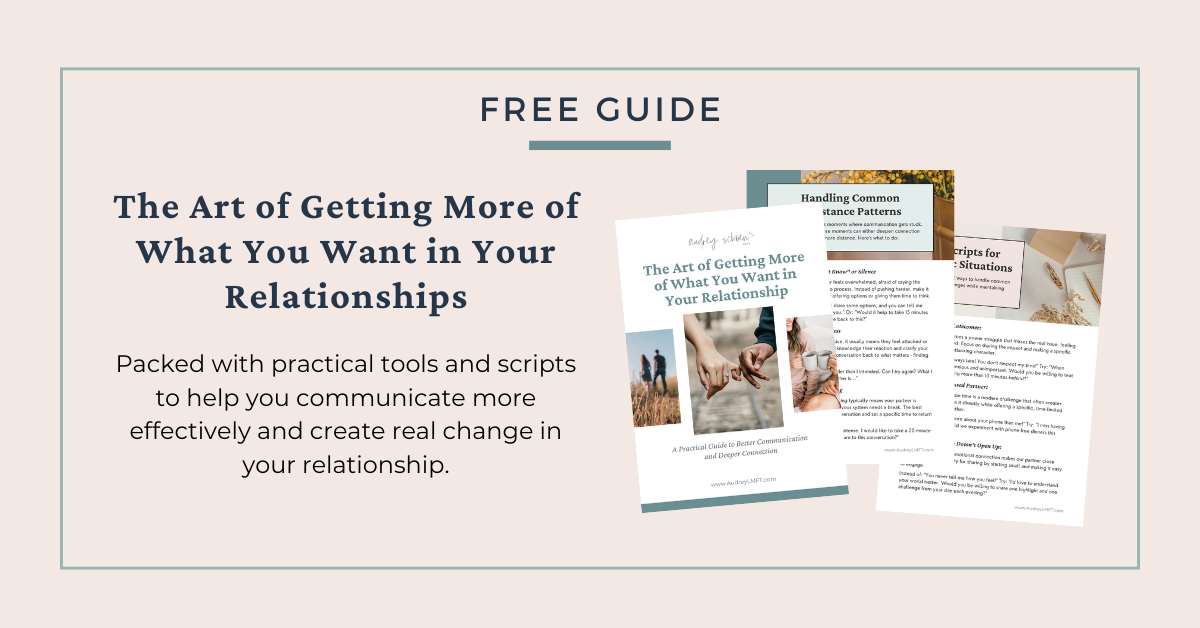
Plus, you'll get relationship tips, book & podcast recommendations, occasional updates, and more.
You can expect to receive about 1-4 emails per month.❤️