Relational Integrity: How to Stay Grounded When Your Partner Isn't
You know that moment when your partner says something that makes your blood boil? When every fiber of your being wants to snap back, shut down, or give them the silent treatment they "deserve"?
That's the moment relational integrity matters most.
And that's also the moment it feels nearly impossible to pull off.
Relational integrity isn't about being perfect or suppressing your emotions. It's not about letting your partner walk all over you while you smile and nod. It's about something much harder: doing the right thing regardless of what's happening with your partner.
It's choosing to stay regulated when they aren't. Choosing to take a timeout when they're yelling. Hearing past a poor delivery. Managing yourself. Being accountable to your behavior and choices in the relationship.
No excuses. No permission. No "if they wouldn't X, then I wouldn't have to Y."
Nothing justifies poor behavior. Nothing your partner does or says gives you permission to behave badly.
And yes, I know how unfair that sounds when you're the one who feels wronged.

What Relational Integrity Actually Means
Let's break this down into what relational integrity looks like in real life, because the concept can feel abstract when you're in the middle of a heated argument at 10 PM on a Tuesday.
Relational integrity means staying connected to yourself AND your partner while taking responsibility for yourself when you're activated. It means noticing the story you're making up in your head—"They always do this" or "They don't care about me"—and taking ownership of the story, right or wrong. It means feeling yourself getting heated and choosing not to let that reactivity drive your words or behaviors.
Think about it like this: You can feel furious. You can feel hurt, dismissed, misunderstood, or absolutely done. Those feelings are valid and real. But relational integrity is about the space between feeling something and acting on it. It's that critical pause where you decide what kind of partner and person you want to be, regardless of what kind of partner or person they're being in that moment.
This is especially important in my work with couples using Relational Life Therapy. I see it constantly—one partner's dysregulation triggers the other's, and suddenly you're in a cycle where nobody's acting like their best self. Breaking that cycle requires one person to manage themselves differently, even when it feels like the last thing you want to do.
Relational Integrity in Action: What It Actually Sounds Like
On the flip side, relational integrity is also about setting firm and loving limits. Because staying grounded doesn't mean becoming a doormat. You can hold boundaries while staying respectful. You can advocate for yourself without attacking.
That might sound like:
"I want to hear you out, can you please soften your voice."
"I can tell this is really important to you. I want to talk about this. I need 20 minutes to center myself and we can try again."
"I love you. I know this is important. I don't want to fight about it. Let's try again tomorrow."
Notice what's happening in these statements: You're acknowledging the importance of the conversation. You're expressing your needs clearly. You're maintaining connection while also protecting yourself from an interaction that's headed south.
These aren't magic words that will instantly transform your fights. But they can act as a circuit breaker, stopping the old patterns in their tracks. Your partner might not respond well. They might push back or escalate further. But you're doing your part—which is the only part you can actually control.
In my practice, I help couples develop these kinds of responses through a combination of insight-oriented therapy and practical skill-building. We identify what happens in your body when you start to get activated (tight chest, clenched jaw, racing thoughts), and we create a game plan for what you'll do when that happens. Because in the heat of the moment, your brain isn't going to come up with this stuff on its own.
The Uncomfortable Truth About Relational Integrity
Let me be honest with you about something: Relational integrity can be lonely sometimes.
When your partner picks a fight and won't back down, when they're coming at you with everything they've got, and you choose to take some distance with a timeout—that can feel isolating. You're doing the right thing, the mature thing, the thing that protects the relationship long-term. But in that moment? It might feel like you're the only one trying.
And relational integrity can also be deeply unsatisfying. It feels good to yell when you're mad. It feels good sometimes to let them have it. It feels righteous to ice them out, to make them feel a fraction of what you're feeling.
But it does more harm than good. It feeds disconnection. It creates the exact dynamic you're trying to escape.
The path to not just repair, but prevention, is relational integrity.
I work with a lot of law enforcement spouses who experience this acutely. Their partners come home from incredibly stressful shifts, sometimes bringing that intensity into the home. The instinct might be to match that energy, to fight fire with fire. But relational integrity means staying grounded even when your partner can't. It means being the regulated presence in the relationship, not because it's fair (it's often not), but because someone has to interrupt the cycle.
You Can't Control Your Partner, But You Can Manage Yourself
Here's what I want you to understand: You can't control your partner. But you can manage yourself with relational integrity.
This is probably the hardest pill to swallow in couples therapy. You came in wanting to fix them, wanting me to tell them why they're wrong and you're right. But the work always comes back to you—not because you're the problem, but because you're the only variable you can actually change.
Managing yourself with relational integrity means owning your impact. When you snap, shut down, or bring edge to your voice—that's yours. Not because of what they did, but because of how you chose to respond. And recognizing the negative impact it has on your partner and the relationship.
Let me be clear: This isn't about stuffing your feelings or pretending everything's fine. You're not a robot. Relational integrity isn't about emotional suppression. It's about engaging honestly, lovingly, and respectfully even when it's hard.
You can say "I'm frustrated and need a minute" instead of slamming doors or attacking. You can say "I need to feel heard right now" instead of stonewalling. You can say "I'm too activated to have this conversation productively" instead of saying things you'll regret.

Taking Responsibility for Your Side of the Street
The first step to repairing any relationship is making the commitment to manage yourself with relational integrity regardless of what's happening on the other side. Stay present, honest, and respectful.
When you need space, take it with integrity too. Tell your partner what's happening and when you'll come back. Don't disappear or punish with silence.
Real relational integrity sounds like:
"I'm getting too heated and I'm worried I'll say something I don't mean. I'm going to take 30 minutes and then I'll be back so we can finish this conversation."
"I can feel myself shutting down. I need to pause this. Can we pick it up after dinner?"
"I'm noticing I'm making assumptions about what you meant. Can you help me understand what you were actually trying to say?"
Compare that to what happens without relational integrity:
Storming out without explanation
Going silent for hours or days
Responding to their intensity with your own
Bringing up past grievances to deflect from the current issue
Name-calling, personal attacks, or intentionally hurtful comments
Because the truth is, your job is YOU. Always.
You might be thinking, "But what if I'm the only one doing this? What if I manage myself with relational integrity and they don't?"
Valid question. And the answer is both encouraging and challenging: When you consistently show up with relational integrity, you change the dynamic. You stop participating in the escalation cycle. You model what healthy conflict looks like. You create space for something different to happen.
Does that mean your partner will automatically change? No. They might continue their patterns for a while. They might not immediately recognize or appreciate what you're doing. But you're doing something crucial—you're breaking your side of the negative cycle. And that's always worth doing, regardless of whether it prompts immediate change in your partner.
Making the Shift: Where to Start
If you're reading this and thinking, "Okay, I want to do this, but how?" — start here:
Notice your activation. What happens in your body when you start to get upset? Does your chest tighten? Do you feel heat rising? Does your mind race? Get familiar with your early warning signs. The earlier you catch it, the easier it is to manage.
Create space. When you notice you're activated, create space before responding. Even a few seconds of pause can be the difference between a productive conversation and one that blows up.
Get curious instead of certain. When you find yourself absolutely sure about what your partner meant or why they did something—pause. Ask. "When you said X, did you mean Y?" Often, we're reacting to our interpretation rather than their actual intention.
Own your behavior. When you mess up (and you will, because you're human), acknowledge it quickly. "I shouldn't have raised my voice. That wasn't okay." Full stop. No "but you..." — just ownership.
Take real timeouts. If you need space, take it properly. Tell your partner you need time, give them a timeframe for when you'll reconnect, and actually come back when you say you will.
The Bottom Line on Relational Integrity
Relational integrity isn't easy. Nobody's going to give you a medal for choosing to stay regulated when your partner is losing it. You might not even get immediate acknowledgement from your partner.
But you'll know. You'll know you showed up as the person you want to be. You'll know you chose connection over being right. You'll know you did your part, regardless of whether they did theirs.
And over time, that consistent choice to manage yourself with integrity—even when it's uncomfortable, unsatisfying, or lonely—is what builds trust, respect, and genuine intimacy.
Your partner can't control your behavior. Their dysregulation, their poor delivery, their mistakes—none of those give you permission to abandon your own integrity.
You get to choose who you are in this relationship. Every single day. Every single interaction. That's both the challenge and the gift of relational integrity.
If you're struggling to maintain relational integrity in your relationship, or if you're the only one trying and don't know how much longer you can keep it up, therapy can help. I work with individuals and couples both in-person in Roseville and online throughout California and Texas.
Through a combination of insight-oriented therapy and faster-working interventions like Brainspotting and Accelerated Resolution Therapy, we'll get to the root of what's keeping you reactive and help you build the skills to stay grounded even in challenging moments.
Reach out for a free 20-minute consultation. Let's talk about what's happening in your relationship and whether working together makes sense for you.
Because relational integrity isn't about being perfect. It's about being intentional. And that's something you can start practicing today.
SIGN UP TO MY NEWSLETTER AND GET THE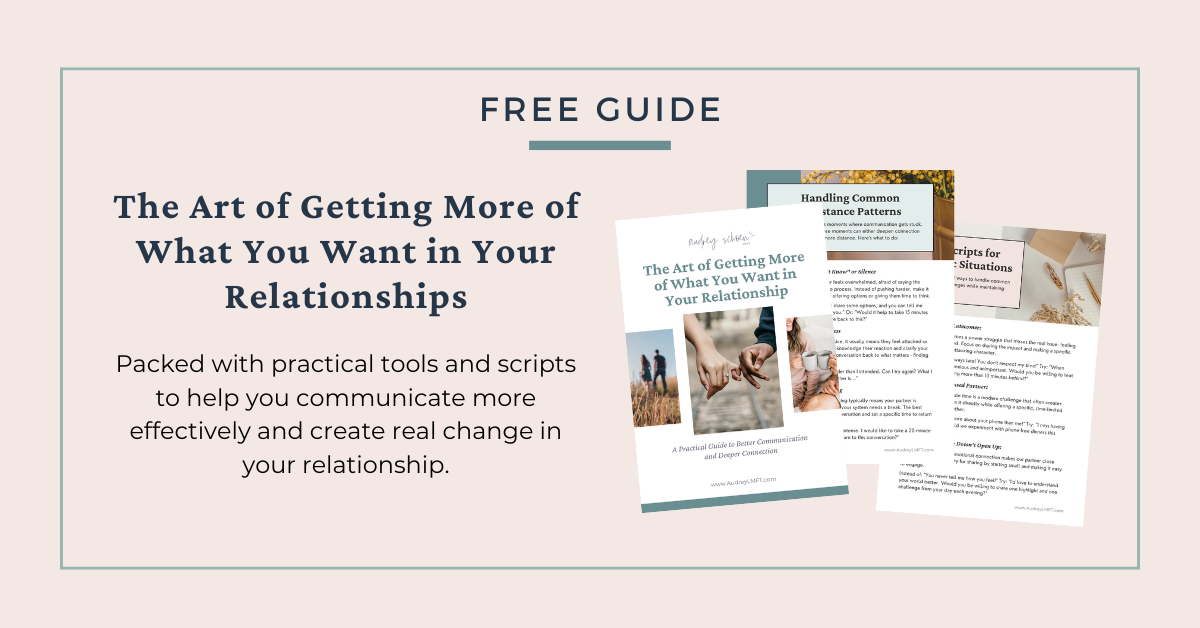
Plus, you'll get relationship tips, book & podcast recommendations, occasional updates, and more.
You can expect to receive about 1-4 emails per month.❤️