Loving Firmness: How to Set Boundaries Without Fighting (And Actually Get Through to Your Partner)
You've asked nicely. You've hinted. You've complained. You've even yelled.
And for a day or two, maybe a week if you're lucky, things get better. Then it all slides right back to how it's always been. You're exhausted. Your partner seems clueless. And you're starting to wonder if anything will ever actually change.
What if I told you there's a different way? One that doesn't require you to be a doormat or an angry dictator?
It's called loving firmness. And no, it's not some soft, wishy-washy approach where you pretend everything is fine. It's actually the opposite. It's direct, grounded, and kind—all at the same time. It's learning to hold your boundaries while showing understanding. Soft and powerful, all at once.
Sound impossible? Keep reading.
What Loving Firmness Actually Is (And Why It Matters)
Loving firmness is the practice of setting clear, non-negotiable boundaries while maintaining compassion and connection. Think of it as the sweet spot between "I'll just do everything myself" and "Why don't you ever help around here?!" It's a third option most of us never learned growing up.
Most people swing like a pendulum between two extremes. We're either accommodating (saying yes when we mean no, doing things we resent, keeping quiet) or we're exploding (yelling, criticizing, making demands when we're at our limit). Neither works for long. Accommodating builds resentment. Exploding damages connection. And both leave you feeling more alone than before.
Loving firmness is different because it refuses to sacrifice either your boundaries or your relationship. It says: I care about you. I also care about me. And we need to find a way forward that honors both.

What We Usually Do Instead (And Why It Doesn't Work)
Let's be real about what most of us actually do when something bothers us in a relationship.
We complain. "You always leave your dishes in the sink." "You never help with the kids." "Why do I have to do everything?"
We hint. We sigh loudly. We bang cabinet doors. We make passive comments hoping they'll pick up on our frustration without us having to be direct.
We suggest. "Maybe you could help with dinner tonight?" "It would be nice if you put your phone away sometimes." We frame our needs as optional requests, then feel hurt when they're treated as such.
We hope. We tell ourselves it will get better on its own. That they'll eventually notice. That if we're patient enough, they'll change.
We yell and fight. Finally, after weeks or months of bottling it up, we lose it. We're angry, accusatory, and often cruel. And yes, maybe things shift for a few days. But without a real plan, without clear expectations, without follow-through, it all goes back to normal.
The pattern looks like this: Ask politely → Get ignored → Ask again → Get ignored again → Explode → Brief change → Back to business as usual. Rinse and repeat until you're both exhausted.
This approach fails because it lacks two critical ingredients: clarity and consequence. Your partner doesn't fully understand what you need or how serious you are. And you haven't made it clear what happens if things don't change.
What Loving Firmness Looks Like in Real Life
Scenario 1: The Volume Problem
Your partner's voice is getting louder. They're angry, and you can feel yourself starting to shut down or gear up for a fight.
What you want to say: "Stop yelling at me!" or "How dare you talk to me that way!"
Loving firmness instead: "Honey, I want to hear you. Can you soften your tone and slow down?"
Notice what's different. You're not attacking them for being angry. You're not matching their intensity. You're acknowledging their emotion ("I want to hear you") while setting a clear boundary about how you'll engage ("soften your tone and slow down").
You're not demanding they stop feeling angry. You're asking them to express it differently. That distinction matters.
Scenario 2: The Phone-on-the-Couch Partner
It's evening. You're frantically managing dinner, homework, and multiple small humans who all need something right now. Meanwhile, your partner is on the couch, lost in their phone.
What you want to say: "What's wrong with you? Don't you see I need help here?"
Loving firmness instead: "I'm sure you could use time to unplug—we both do. Right now we need to work together. I'll do dinner. Would you like homework or bath duty?"
You're acknowledging their need for rest (because it's real and valid). You're making it clear that right now isn't the time. And you're offering specific, concrete options instead of waiting for them to magically read your mind (even if these are things that need to happen everyday and they should already know).
Scenario 3: The Recurring Issue
You've addressed something before. Multiple times. And it keeps happening. Now you need to have a harder conversation.
What you want to say: "I've told you a thousand times! Why don't you listen?"
Loving firmness instead: "I've brought this up before, and I need you to hear me clearly. This isn't working for me, and if it continues, it will damage our relationship. I need [specific behavior] to change. What do you need from me to make that happen?"
You're being direct about the seriousness without being dramatic. You're naming the consequence (damage to the relationship) without threatening or manipulating. And you're inviting collaboration by asking what they need.
"But I Shouldn't Have to Ask!"—Addressing Your Resistance
I can feel it from here. The pushback. The frustration.
"I've already told them."
"I've said it a million different ways."
"I shouldn't have to ask my partner not to yell at me."
"I shouldn't have to ask them to be an equal partner."
And you're right. You shouldn't.
In an ideal world, your partner would notice. They'd anticipate. They'd just know what you need and do it without being asked. But we don't live in that world. We live in this one, where two imperfect humans are trying to navigate life together, often bringing completely different maps to the journey.
What you've been doing hasn't worked so far. Because most of us only know how to exist at two extremes. We ask nicely (with no real teeth behind it), and when that doesn't work, we demand angrily. Then we stand by silently, doing what we've always done, without a follow-up plan. Without firm limits. Without consequences when things slide back.
Loving firmness requires you to try something different. Not because it's fair. But because you deserve a relationship that actually works.
The Missing Piece: Follow-Through
This is where most people lose the plot. They set the boundary beautifully, their partner nods, maybe things shift for a hot minute, and then...nothing sticks. Everyone's back to old patterns, and you feel more defeated than before.
The problem isn't your boundary-setting. It's your follow-through.
Loving firmness isn't just about what you say in the moment. It's about what you do next. It's about being willing to follow through with the consequence you named—even when it's uncomfortable.
Let me be clear: I'm not talking about punishment. I'm talking about natural consequences that reflect the reality of what happens when boundaries aren't respected.
Some examples:
If your partner continues to raise their voice after you've asked them to stop, you leave the room. "I'm not willing to have this conversation at this volume. I'm going to step away. We can try again when we're both calm."
If they commit to helping with evening routines and consistently zone out on their phone instead, you stop covering for them. "You said you'd handle bath time. The kids are waiting."
If a larger pattern continues despite repeated conversations, you might say, "I love you, but this isn't working. We need help. I'm finding a couples therapist, and I need you to come with me."
And yes, if the pattern is severe enough and nothing changes, the consequence might be bigger. Separation. Divorce. It's not dramatic to name that reality. It's honest.
The key is this: when you set a loving, firm boundary, you must be prepared to honor it. Otherwise, you're just making noise. And your partner—whether consciously or not—learns that your words don't actually mean much.
Why This Approach Actually Works

Loving firmness works because it removes the two biggest obstacles to real change in relationships: confusion and defensiveness.
When you're clear, specific, and kind, your partner knows exactly what you need. There's no guessing. No mindreading. No "Well, I didn't know it was that serious."
When you approach them with compassion instead of criticism, their defenses stay down. They're more likely to actually hear you instead of gearing up to fight back or shut down.
In my work with couples, I've seen this shift happen again and again. One partner learns to say what they mean without the anger or resentment clouding the message. The other partner finally gets it because they're not too busy defending themselves to listen.
This is what Relational Life Therapy is all about—teaching couples to move from adversarial stances to collaborative ones. To see each other as teammates instead of opponents. And that starts with learning to communicate with both honesty and respect.
How to Actually Implement Loving Firmness (The Practical Steps)
Knowing about loving firmness and actually doing it are two different things. So let's break down how to start implementing this in your relationship today.
Step 1: Get Clear on What You Actually Need
Before you can communicate a boundary, you need to know what it is. And that's harder than it sounds.
Most of us operate on vague frustration. "I need more help." "I need you to be more present." "I need you to care more."
That's not specific enough.
Or we have a list of criticisms, all the things that are wrong. All the ways our partner is failing.
That’s not solution oriented
Sit down and ask yourself: What exactly do I need? What specific behavior would need to change for me to feel better? What would "more help" or "more present" actually look like? Turn criticisms into specific requests that your partner can deliver on.
For example:
Instead of "I need more help," try "I need you to handle bath time while I prepare dinner each night."
Instead of "I need you to be more present," try "I need you to put your phone in another room during dinner and our evening routine."
Specificity matters. It's the difference between a request that can be met and one that will continue to frustrate both of you.
Step 2: Choose Your Timing
Don't try to set a boundary in the heat of the moment. You won't have access to your thinking brain. Neither will your partner.
Pick a time when you're both relatively calm. When you're not already triggered or exhausted. Frame it as something important you want to discuss, not an ambush.
"Hey, I want to talk about something that's important to me. Is now a good time, or should we set aside time later?"
Giving them a heads-up and a choice helps them show up ready to actually engage instead of defensive and caught off guard.
Step 3: Use the Formula
When you're ready to have the conversation, use this structure:
Acknowledge their reality: "I know you've had a long day" or "I know you're stressed about work."
State your experience clearly: "I've been feeling overwhelmed managing everything in the evenings."
Make a specific request: "I need you to take over bath time and bedtime for the kids on Mondays, Wednesdays, and Fridays."
Invite collaboration: "What would help you make that happen?"
This formula keeps you in loving firmness territory. You're not attacking. You're not minimizing. You're being honest, specific, and open to problem-solving together.
Step 4: Name the Consequence (If Needed)
If this is an ongoing issue or something particularly serious, you might need to add one more element:
State the consequence clearly: "If this continues, I will [specific action]. I don't want to do that, but I need you to understand how important this is to me."
Again, this isn't punishment. It's being honest about what will happen if the boundary isn't respected.
Step 5: Follow Through Every Single Time
This is the part where most people falter. They set the boundary beautifully and then don't enforce it when tested.
If you said you'd leave the room when your partner yells, you have to actually leave the room. If you said you wouldn't have this conversation after 10 PM anymore, you have to stick to that. If you said you need them to show up in specific ways and they don't, you have to follow through with the consequence.
Otherwise, you're teaching them that your boundaries are flexible. And flexible boundaries aren't really boundaries at all.
When Loving Firmness Isn't Enough
Sometimes, even with the best communication in the world, patterns don't change.
Maybe your partner hears you but doesn't follow through. Maybe they want to change but don't know how. Maybe there are deeper wounds, unprocessed trauma, or ingrained patterns from their own childhood that keep getting in the way.
This is where therapy comes in.
In my practice, I work with individuals and couples to identify the root causes of recurring conflicts. We don't just address surface-level communication issues. We go deeper—to the beliefs, the fears, the old wounds that drive your current patterns.
Using approaches like Relational Life Therapy, Brainspotting, and Accelerated Resolution Therapy, we can often create shifts quickly. Faster than you might expect. Because when you get to the actual root of what's happening—not just the symptoms—real change becomes possible.
If you've been trying to implement loving firmness and it's still not landing, that's not a failure on your part. It might just mean you need support. Someone outside the relationship who can see the patterns you're both stuck in and help you find a way out.

Loving Firmness Is a Practice, Not a Personality Trait
You don't have to be naturally assertive to do this. You don't have to be confrontational or good at conflict.
Loving firmness is a skill. Which means it's something you can learn, practice, and improve over time.
Will it feel awkward at first? Probably. Will you mess it up sometimes? Definitely. Will your partner look at you like you've grown a second head the first few times you try it? Maybe.
That's all normal.
The goal isn't perfection. The goal is progress. Every time you choose to be clear instead of passive, firm instead of accommodating, loving instead of critical, you're building new neural pathways. You're teaching yourself—and your partner—that there's a different way to navigate conflict.
Over time, it gets easier. You'll find your own voice in it. Your own rhythm. And your relationship will start to shift in ways that feel more sustainable, more authentic, and more connected.
The Bottom Line
Loving firmness is about refusing to choose between yourself and your relationship. It's about believing that you can have both boundaries and connection. That you can be honest and kind. That you can stand firm and stay soft.
It's not about controlling your partner or forcing them to change. It's about being clear about what you need, compassionate about where they're coming from, and committed to following through when boundaries are tested.
Most of all, it's about recognizing that the patterns you're stuck in didn't develop overnight. They're the result of years of conditioning, past wounds, and learned behaviors. Changing them takes intention, practice, and often, professional support.
If you're tired of the cycle—the asking, the ignoring, the explosion, the temporary change, the return to normal—it's time to try something different.
I help individuals and couples in California and Texas untangle these patterns and build relationships that actually work. Using fast-working interventions that get to the root of issues quickly, we can create relief beyond what talk therapy alone can offer.
My approach is practical, direct, and tailored to your specific situation. I'll tell you the truth, even when it's uncomfortable. I'll validate your experience while also challenging you to show up differently. And I'll work alongside you to build the skills and awareness you need for lasting change.
Real change doesn't have to take years. With the right approach and the right support, you can feel better—and communicate better—faster than you think.
Ready to stop fighting the same battles? Let's talk. Contact me today to schedule your consultation and start building a relationship where loving firmness is the norm, not the exception.
SIGN UP TO MY NEWSLETTER AND GET THE
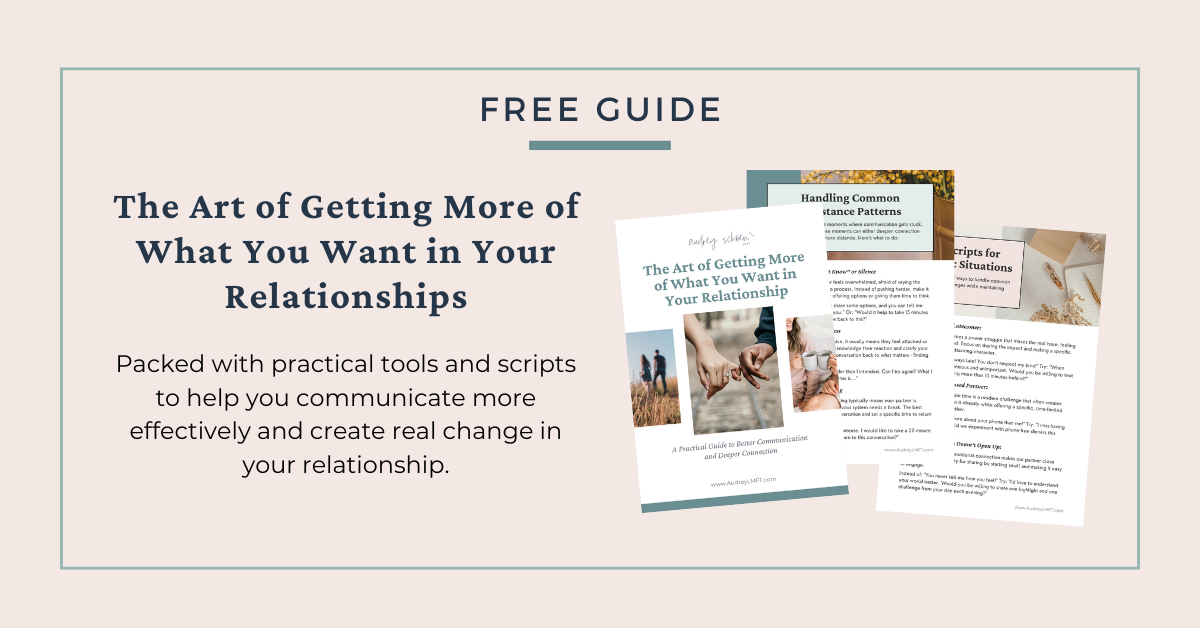
Plus, you'll get relationship tips, book & podcast recommendations, occasional updates, and more.
You can expect to receive about 1-4 emails per month.❤️