Stop Chasing Happiness: Why Contentment Is Your Real Baseline (And How to Get Back There)
You're not broken for not being happy all the time. In fact, if you were happy all the time, something would be seriously wrong.
The self-help industry has sold us a dangerous lie: that happiness is the goal, that joy should be our default state, that if we're not living our "best life" every single day, we're doing something wrong. But this isn't just unrealistic—it's biochemically impossible.
Happiness is a peak state. And like any peak, you can't live there permanently. Your brain literally won't let you.
So what's the alternative? Building a baseline of pleasant contentment. Not excitement. Not euphoria. Just steady ground under your feet. A place you can always return to, no matter how exhilarating or devastating the emotional visit.
Let me show you why this matters—and how to actually get there.

Why Your Brain Can't Sustain Happiness (And Wasn't Designed To)
Your brain is wired for survival, not constant bliss. When something good happens—you get the promotion, you fall in love, you finally buy that house—your brain releases dopamine, serotonin, all the feel-good chemicals. You feel amazing. This is happiness.
But here's the catch: Your brain adapts. Fast. This is called hedonic adaptation, and it's the reason why lottery winners return to their baseline happiness level within a year. Your brain recalibrates to the new normal, and what once felt euphoric becomes... Tuesday.
This isn't a flaw. It's a feature. If your brain stayed in that heightened state of arousal indefinitely, you'd burn out. You'd stop noticing threats. You'd make impulsive decisions. You'd crash, hard.
Happiness is designed to be temporary—a reward signal that says "yes, this is good, keep doing this." It's not meant to be your permanent address.
The same goes for sadness, pain, anxiety, and every other "negative" emotion we're told to avoid. These are information signals. Temporary states you're meant to visit, process, and move through. Not set up camp in, but also not run screaming from.
What Contentment Actually Is (And What It's Not)
When I talk about contentment as your baseline, I'm not talking about resignation. I'm not suggesting you "settle" or lower your standards or stop wanting more from life.
Contentment isn't apathy. It's not sitting on your couch saying "well, I guess this is fine" while your life falls apart around you.
Contentment is stability. It's the emotional equivalent of standing on solid ground. From that place, you can experience the full range of human emotion without losing yourself in it.
Think of it like this: Happiness is visiting the mountains. Sadness is visiting the ocean during a storm. Contentment is your home base—the place you leave from and return to. You don't stay on the mountain forever. You don't need to. You visit, you experience it fully, and then you come back to center.
Contentment is trusting that you can weather any emotional experience and still find your way back.
That trust? That's what most people are actually missing. Not happiness. Trust in their own resilience. Trust that the crash won't destroy them. Trust that the pain won't be permanent.
The Real Cost of Chasing Happiness
Chasing happiness is exhausting. And it's making you miserable in ways you might not even recognize.
When happiness becomes the goal, everything else becomes evidence of failure. You have a bad day? Something must be wrong. You feel anxious? You need to fix it immediately. You're not excited about your life? You're clearly doing something wrong.
This creates what I call the "happiness trap"—the more you chase it, the more elusive it becomes. Because you're so focused on the destination that you can't be present for the journey. You're constantly evaluating: Am I happy yet? How about now? What about now?
It's like trying to fall asleep by thinking really hard about falling asleep. The effort itself becomes the obstacle.
And the flip side—avoiding pain—creates its own set of problems. When you make sadness, anger, grief, or disappointment the enemy, you're basically telling yourself that a huge chunk of human experience is unacceptable. That you're unacceptable when you feel those things.
So what happens? You numb out. You distract yourself. You work too much, drink too much, scroll too much. Anything to avoid sitting with discomfort.
But pain that isn't processed doesn't disappear. It goes underground. It shows up in your body as tension, in your relationships as disconnection, in your life as a vague sense that something's... off.
In my work with clients—whether through Relational Life Therapy, Brainspotting, or Accelerated Resolution Therapy—I see this pattern constantly. People come in saying they want to be happier. What they actually need is to learn how to be with themselves when they're not happy.
What Returning to Baseline Actually Looks Like
Okay, so contentment is the goal. But what does that actually mean in practice?
It means building the skill of emotional regulation—not suppression, regulation. The ability to feel what you feel without either getting swallowed by it or running away from it.
When you visit joy, you're present for it. You feel it fully. You don't try to cling to it or make it permanent. You know it's temporary, and that's okay. That's what makes it precious.
When you visit grief, you let yourself feel it. You don't rush through it or tell yourself you "should" be over it by now. You acknowledge that loss hurts, that disappointment is real, that you're allowed to feel whatever you feel.
And then—this is the crucial part—you come back to center.
Not because you've "fixed" anything or "gotten over" anything. But because you trust that contentment is still there, waiting for you. Your baseline hasn't disappeared just because you took an emotional detour.
This is radically different from the "good vibes only" approach. You're not pretending everything is fine. You're not bypassing your feelings with affirmations or gratitude lists. You're actually processing your experience—and then returning to a place of stability.
How This Shows Up in Relationships
This concept becomes especially important in relationships. Because when you're chasing happiness, your partner becomes responsible for providing it. And when you're avoiding pain, your partner becomes the enemy every time they trigger discomfort.
Neither of these dynamics works.
In Relational Life Therapy, we talk about the difference between harmony and peace. Harmony is when everything feels good—you're connected, you're laughing, you're on the same page. It's wonderful. It's also temporary.
Peace is something deeper. It's the trust that even when you're disconnected, even when you're in conflict, even when one of you is struggling, the relationship can handle it. You'll find your way back to each other.
That's contentment at the relational level.
When your baseline is "we're okay," you can handle the inevitable ups and downs without panicking. You don't need your partner to be your source of constant happiness. You don't need to avoid every difficult conversation to keep the peace.
You can be honest. You can be messy. You can have a terrible day and bring that terrible day home without it meaning your relationship is falling apart.
This is what I mean when I say I'm committed to showing up authentically—to being honest about my own mistakes, bold when necessary, and validating of your experiences. Because real relationships aren't built on constant happiness. They're built on the trust that you can weather anything together and still find your way back to center.

The Fast-Working Interventions That Actually Help
In my practice, I use approaches that get to the root of these patterns quickly—because talk therapy alone often isn't enough when you're stuck in the happiness trap or drowning in emotional avoidance.
Brainspotting helps you access and process the stored emotional experiences that keep you from returning to baseline. Sometimes the inability to find contentment isn't a mindset problem—it's unprocessed trauma or stress that's keeping your nervous system in a chronic state of activation.
Accelerated Resolution Therapy can rapidly reduce the emotional charge around painful memories or experiences, making it easier to move through them instead of getting stuck. This is especially helpful when you're white-knuckling your way through life, trying to avoid triggers.
Relational Life Therapy addresses the relational patterns that keep you chasing external validation or avoiding necessary conflict. It helps you build the skills to stay connected to yourself and others, even when things get uncomfortable.
These aren't band-aid solutions. They're interventions that address the root issue—the disconnection from your own baseline, the lack of trust in your ability to self-regulate, the patterns that keep you cycling between emotional extremes.
Practical Steps to Find Your Baseline (And Keep Coming Back)
So how do you actually do this? How do you stop chasing happiness and start building contentment?
Notice your current baseline. What does "normal" feel like for you right now? Not good, not bad—just your default state. Are you chronically anxious? Mildly depressed? Numb? You can't change what you don't acknowledge.
Stop grading your days by happiness. Instead of asking "Was I happy today?" ask "Did I feel present? Did I handle what came my way? Did I stay connected to myself?" These are better measures of well-being.
Practice staying with discomfort for short periods. When you feel anxious, sad, or frustrated, don't immediately reach for distraction. Sit with it for 60 seconds. Notice where you feel it in your body. Breathe. Then move on. You're building the muscle of tolerance.
Identify what actually brings you back to center. Not what makes you happy—what helps you feel grounded. For some people, it's walking. For others, it's talking to a friend, cooking, sitting in silence. Find your reset buttons.
Track your emotional visits. Notice when you leave baseline and when you return. How long do you stay in heightened emotional states? What helps you come back? This awareness alone is powerful.
Challenge the "should" narratives. "I should be over this by now." "I should be grateful." "I should be happy." These aren't helpful. They're judgment masquerading as motivation. Let them go.
Get support when you need it. If you can't find your baseline, if you're chronically stuck in anxiety or depression, if you've been chasing happiness for so long you've forgotten what contentment feels like—that's what therapy is for.
The Goal Isn't to Avoid Pain. It's to Trust Yourself Through It.
You will visit joy. You will visit grief. You will experience moments of pure happiness and days of bone-deep sadness. That's not a bug in your system. That's being human.
The question isn't whether you'll experience the full range of emotions. You will. The question is: Can you trust yourself to handle them? Can you believe that no matter how exhilarating or devastating the visit, you know the way back home?
Contentment isn't about feeling less. It's about creating enough internal stability that you can feel everything without losing yourself.
That's the work. Not chasing happiness. Not avoiding pain. Building trust in your ability to weather any emotional experience and still find your way back to center.
That's what changes everything.
Ready to Stop Chasing and Start Building?
If you're exhausted from trying to be happy all the time, if you're tired of feeling like you're failing at life every time you're not "on," if you want to learn how to actually trust yourself through the full range of human experience—I can help.
I work with individuals and couples in Roseville, CA (in-person) and throughout California and Texas (online). My approach uses fast-working interventions like Relational Life Therapy, Brainspotting, and Accelerated Resolution Therapy to get to the root of what's keeping you stuck.
I provide superbills for potential reimbursement using out-of-network benefits, and our work together starts with an in-depth intake that allows us to track your progress over time. From there, we'll typically meet weekly or every two weeks, tailoring treatment to your specific needs and goals.
I'm comfortable with uncomfortable topics—whether we're talking about sex, money, relationships, or the messy reality of being human. And I'm committed to showing up authentically, which means I'll be honest, validating, and occasionally bold when you need it.
Reach out to learn more about working together. Let's build a foundation that actually holds.
SIGN UP TO MY NEWSLETTER AND GET THE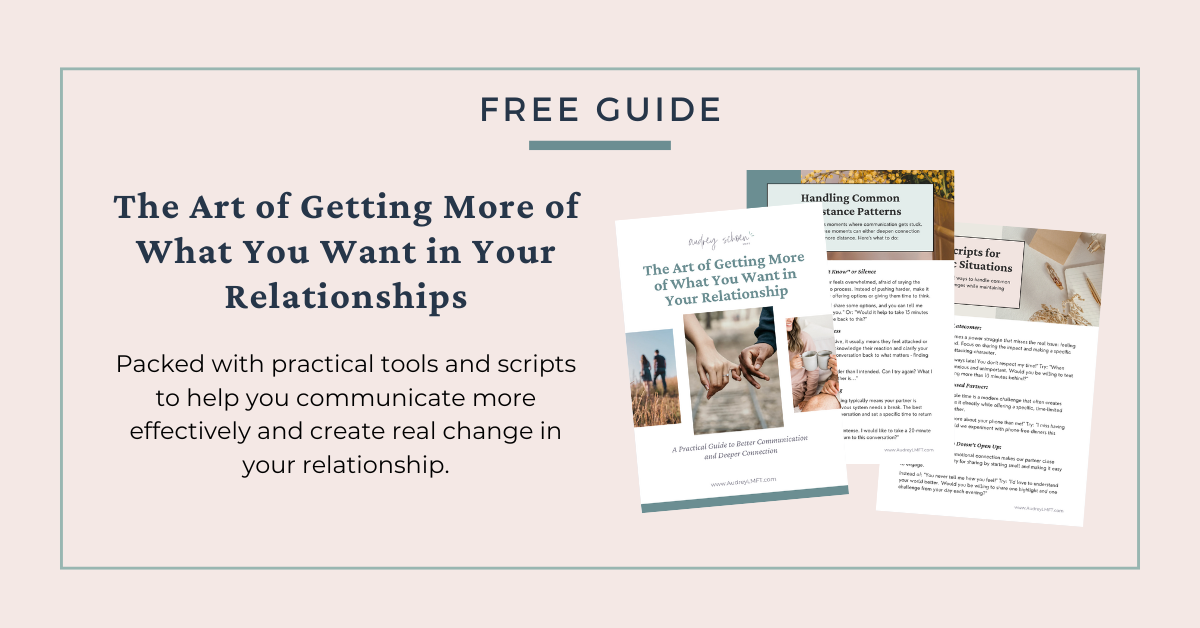
Plus, you'll get relationship tips, book & podcast recommendations, occasional updates, and more.
You can expect to receive about 1-4 emails per month.❤️