
Relationships Aren't Inherently Safe
There is no such thing as a "safe" relationship, at least not how we usually think about it.
If that made you bristle, stay with me. I'm not saying your relationship is doomed. I'm saying the way most of us define safety sets us up to fail.
Connection Requires Vulnerability
Connection requires vulnerability. Vulnerability requires risk. And your partner is imperfect.
Put those three together and the math is simple. If you could guarantee how the other person would respond, it wouldn't be vulnerability. It would be a transaction. Real closeness means putting something tender on the table without knowing exactly what happens next.

image from unsplash by Noë Baeten (@noebaeten)
What We Usually Mean by "Safe"
In relationships today, what we usually mean by safe is an expectation that "you" will never do xyz to me and hurt me.
Translated, it sounds like this. I want you to never do anything that makes me uncomfortable or causes me pain. And if you do, this relationship is not safe.
Underneath that sits a belief most of us never say out loud. We believe it's the other person who is supposed to create safety. Your partner's job is to get it right, and your job is to notice when they don't.
Read that back slowly. Your partner is a human being with their own history, their own bad days, and their own blind spots. They will say the wrong thing. They will forget the thing that mattered to you. Some nights they'll be tired and short with you. Under this definition, every relationship fails the safety test eventually. You're always one rough Tuesday away from "this isn't safe."
If you run a business or a company, this might sound familiar. You take risks all day. You make calls without full information and you live with the outcome. Then you come home and expect zero risk. Your partner can't deliver that, and no one else could either.
Safety Is Something We Create Within Ourselves
In Relational Life Therapy (RLT), safety is something we create within ourselves, even in difficult moments.
That doesn't mean white knuckling your way through hard conversations. It means you stop outsourcing your sense of steadiness to your partner's perfect behavior. When something stings, you get curious about what's happening in you. You slow down, breathe, and notice what got touched. You stay present instead of going on the attack or going quiet and disappearing.
It's less about "make me feel safe" and more about "I can stay with myself while this is hard."
Creating a Safe Container Together
When both people build safety within themselves, it allows us to create a safe container together. In that container, we both create safety within ourselves and ask each other for the things we need for increased safety.
Notice the two parts. You do your own work, and you ask for what you need. Both matter.
Asking sounds like this.
"Can you slow down? I want to hear you and I'm getting flooded."
"It would really help if you would look at me while I say this."
"Can we take ten minutes and come back to this?"
These are requests, not demands. Your partner gets to be a person who can say yes, or negotiate, rather than a person who failed a test. That is a much more workable relationship than one where you're quietly keeping score of every misstep.
A Quick Note on Real Danger
Discomfort and pain in a relationship are not the same as danger. Feeling stung by your partner's comment is part of being close to another imperfect person. Being afraid of your partner, or being controlled, threatened, or physically hurt, is a different situation and it deserves a different response. If that's your reality, reaching out for support is the priority, and this post is not a call to tolerate it.
How I Work With This
In my solo practice, I use fast working interventions that get to the root of the issue quickly, which can provide relief beyond what talk therapy can do alone. I draw on Relational Life Therapy, Accelerated Resolution Therapy, and Brainspotting, and I keep it practical and down to earth. Your work is tailored to you and your relationship, not a script.
I see clients in person in Roseville, CA, and online throughout California and Texas. I offer superbills for potential reimbursement using out of network benefits. If you'd like to talk about couples work, individual sessions, or a private intensive, reach out and we'll talk through scheduling and pricing.
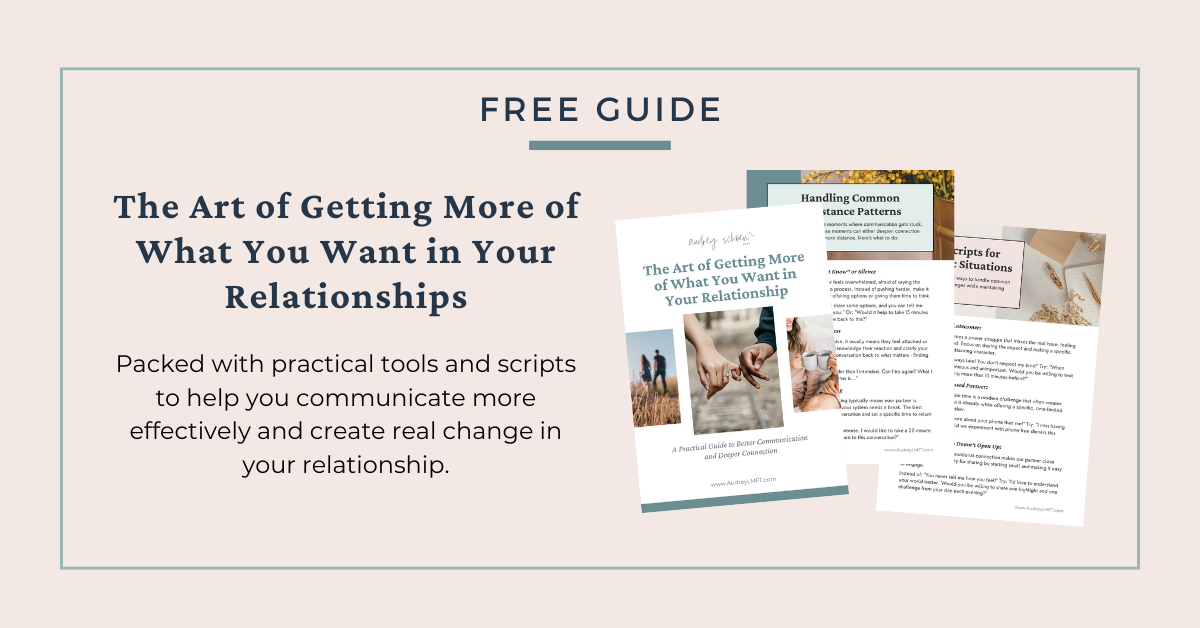
Plus, you'll get relationship tips, book & podcast recommendations, occasional updates, and more.
You can expect to receive about 1-4 emails per month.❤️