

image via unspash by Vitaly Gariev (@silverkblack)
After a decade of working with couples, I've noticed some clear patterns in who does well and who struggles. It has very little to do with how much they love each other, how compatible they look on paper, or how bad things got before they walked into my office. It mostly comes down to what each person does with their own behavior when things get hard.
I know. Nobody wants that answer. We'd all prefer it was about our partner's behavior.
What Does a Successful Relationship Actually Look Like?
When I say a couple is doing well, I don't always mean they stayed together. Sometimes ending the relationship is the best move. The couples I count as successful put in an honest effort and treat each other with respect and compassion. If it doesn't work, they part without torching the house on the way out. And a couple that stays together for 20 years in a cold war isn't winning either.
Radical Responsibility for Yourself Is the Foundation
The couples who thrive share a deep commitment to radical responsibility for the self. No excuses and no permission slips. They take full responsibility for how they think, speak, and behave. When they make a mistake, they own it.
A permission slip is that little voice that says "I'm allowed to be a jerk right now because look at what they did." Everyone has that voice. The couples who do well don't hand them the keys.
Nothing your partner does or says justifies you behaving badly. Nothing. I say that with a lot of love, because I know how hard it is to hear.
Why Anger and Resentment Keep Couples Stuck
Anger and resentment are two of the biggest barriers to repair. Sometimes we feel entitled to behave badly, especially when it looks like our partner isn't doing the work. It feels good to yell when you're mad. It feels righteous to ice them out. It also keeps you exactly where you are.
If I give myself permission to behave badly because my partner is behaving badly, I'm no better. I've colluded in the conflict cycle. I'm keeping it going, and I can't expect things to improve while I'm feeding it.
I know this personally. There was a time in my own marriage when I was so angry, and I felt justified. Yelling, sharp digs, harsh words. My anger may have been justified. My behavior was not. I had to decide what kind of person I wanted to be in the world and in my relationship, and that meant starting with me. How my spouse responded didn't change it. My body and my mouth were my responsibility.
Past pain is valid. It just isn't a hall pass for present behavior.
I'm not saying this work is easy. I'm saying it's necessary.
Why Burnout Makes Couples Struggle
Anger isn't the only culprit. Burnout is one of the most common reasons I see couples stuck in reactive mode. When you're running on fumes, it's much harder to reach the wise adult part of yourself and choose relationality.
In Relational Life Therapy, we talk about the adaptive child and the wise adult. The adaptive child is the part of you that formed early to keep you safe. It snaps, shuts down, keeps score, or goes cold. The wise adult is the part that can pause, get curious, and actually choose a response. A burned out nervous system defaults to the adaptive child every time, because it takes fuel to be the wise adult.
In the couples who struggle, I typically see one or both partners living in those reactive parts most of the time. That's rarely a character flaw. For business owners and high achievers especially, it's often years of building something while the relationship got whatever was left over. By the time they sit down in my office, the exhaustion is showing up at home and at work.
How Successful Couples Handle Conflict Differently
They don't let a fight balloon into something bigger. They let it be a moment. Sometimes a big moment. Sometimes it takes a few days to get back to good. But they've decided that no matter what happens, they will do the work to come back to center.
Both partners make this commitment, though not always evenly. Sometimes they're both doing it, and sometimes they take turns carrying it. Someone often has to go first, and over time both people do their fair share. What matters is consistency. They don't give up on each other, even when it's their turn to be the one who's tired.
The Three Essentials for a Healthy Relationship
Without these three things, nothing else works.
Time outs and circuit breakers. You need a way to stop the escalation before someone says the thing that takes a week to repair. A good time out is agreed on ahead of time and called without blame. It sounds something like "I can tell this is really important to you. I want to talk about this. I need 20 minutes to center myself and then we can try again." You tell your partner when you'll be back, and then you come back. Disappearing or punishing with silence is not a time out. It's a slammed door with better branding.
Radical responsibility and relational mindfulness. Notice what's happening in your body, catch the adaptive child before it speaks, and ask yourself what this argument is moving you toward. Then choose accordingly. This is a skill, and like any skill, it gets better with practice. Your job is you. Always.
Assume good intent. Believe your partner is trying, even when it doesn't look like it. I don't mean the obvious violations like name calling. I mean the subtle attempts to word something differently, approach a situation differently, or contain their upset. Those small efforts are easy to miss when you're hurt, and they're often the beginning of repair.
What If Only One of You Is Doing the Work?
This is the question I hear most. It's frustrating to be the one holding the line when your partner isn't, and I'm not going to pretend otherwise.
Taking responsibility for yourself doesn't mean putting up with abuse or bad behavior. It also doesn't mean keeping score. In fact, it includes setting firm and loving limits that protect the relationship. You can say "I want to hear you, but I can't do it while you're yelling" and mean it. What you don't get to do is match their behavior and call it self defense.
When one person changes their side of the dance, the dance has to change. Not always, and not instantly. But I see it happen far more often than people expect.
Couples Therapy in Roseville, CA and Online Across California and Texas
If you recognize your relationship in the struggling column, you're not doomed. It means there are specific things to work on, and they can shift faster than most people think.
In my solo practice, I use Relational Life Therapy, Accelerated Resolution Therapy, and Brainspotting. I take a practical, down to earth approach. Talk therapy has its place, but I use fast working interventions that get to the root of the issue quickly. That means real relief beyond what talking alone can do. These aren't slow burn approaches, and they're chosen for exactly that reason.
We start with an in depth intake so we can track your progress over time. After that, we meet weekly or every two weeks and check in regularly to make sure we're meeting your goals. Your treatment is tailored to you and your relationship, because no two couples get stuck in quite the same way. If you want to go deeper faster, I also offer couples intensives in one, two, and three day options.
I won't ask you to go anywhere I haven't gone myself. I'm honest about my own mistakes, I'll say the hard things out loud, and I'm comfortable with the topics most people avoid, like sex, money, and gender roles. I'm also a big fan of the humor that tends to show up when people finally get real with each other.
I see clients in person in Roseville, CA and online throughout California and Texas. I offer superbills you can submit for potential reimbursement using your out of network benefits. To ask about pricing and scheduling, reach out and we'll find a time to talk.
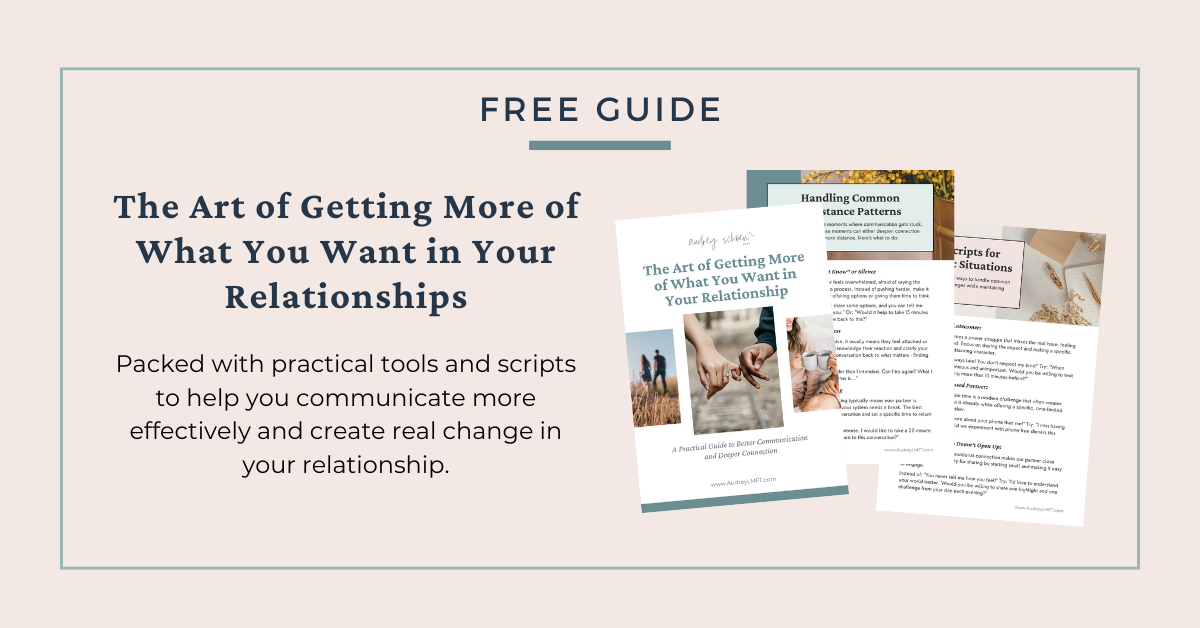
Plus, you'll get relationship tips, book & podcast recommendations, occasional updates, and more.
You can expect to receive about 1-4 emails per month.❤️