The Blueprint You Built at Eight Is Running Your Company: How Childhood Adaptations Show Up in Entrepreneurship
Most successful entrepreneurs are experts at diagnosing problems. Revenue down? Audit the funnel. Team underperforming? Restructure the org chart. Growth stalled? Hire a strategist. But there's a category of problem that strategy can't touch, and it's the one that tends to quietly drive all the others.
The employee who can't push back on you. The client you keep over-delivering for. The partner you avoid the hard conversation with. You've probably filed these under "business problems." They're not. They're relational patterns, and you've likely been running them since childhood.

What Childhood Adaptations Actually Are
When we were young, we figured out how to survive our environments. Not survive in a dramatic sense necessarily, just how to stay safe, stay loved, stay connected to the people we depended on. If the house was chaotic, maybe you became the reliable one. If love felt conditional on performance, maybe you learned to achieve your way to it. If conflict was dangerous, maybe you learned to smooth things over before they could escalate.
These aren't flaws. They were genuinely smart responses to real circumstances. The problem is that our nervous systems don't automatically update the software when the circumstances change. The adaptation that kept you safe at eight years old is still running in the background at forty-two, and now it's managing your company.
In Relational Life Therapy, we'd call this your adaptive child: the part of you that learned how to navigate a world where the rules were set by someone else. It's resourceful, it's fast, and it is absolutely convinced it knows what's safest. What it doesn't know is that you're not eight anymore.
The Three Patterns That Show Up Most in High-Achievers
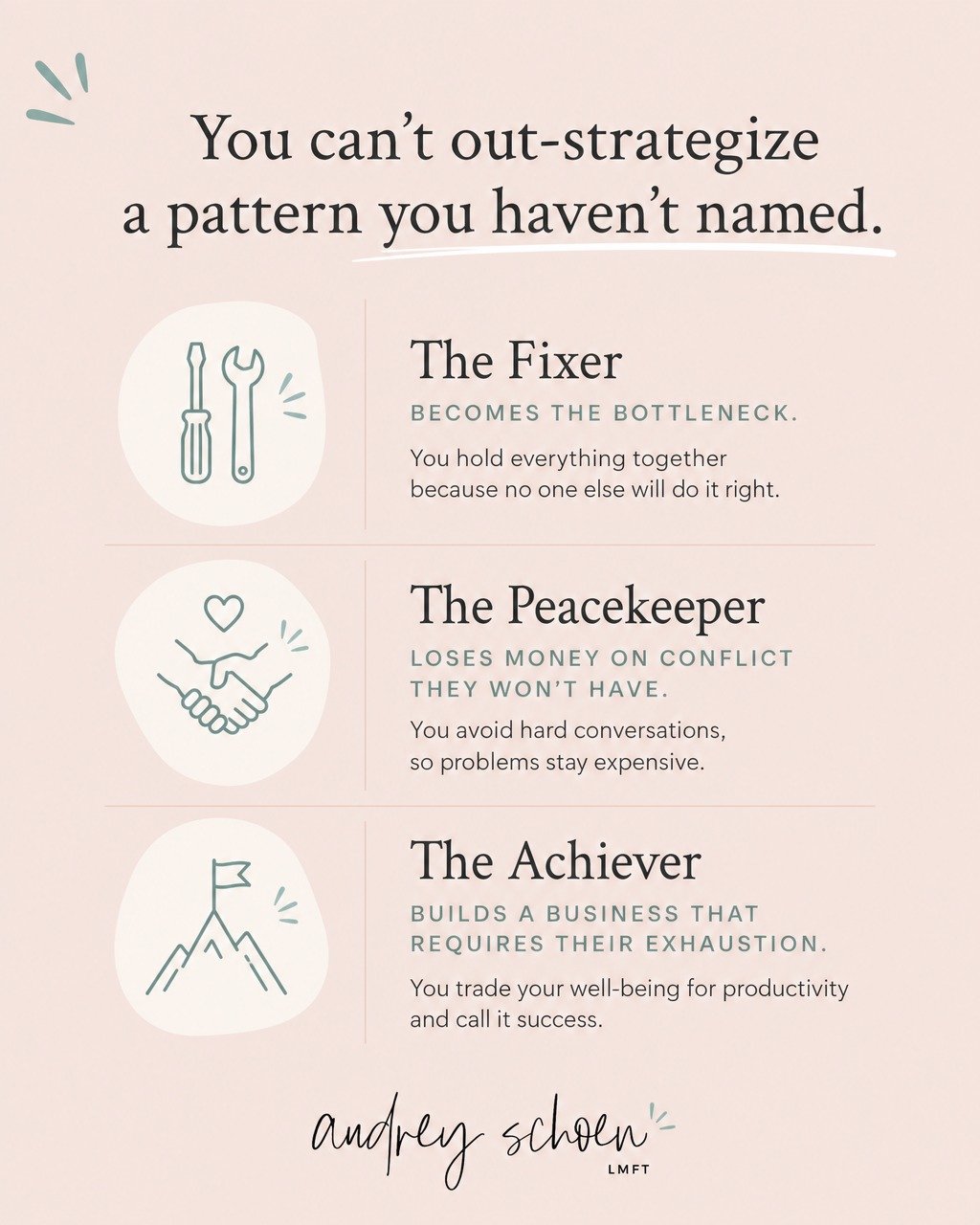
The Fixer
You became indispensable early. Maybe the family needed a problem-solver, or maybe being needed felt safer than simply being seen. Either way, you got really good at handling things. The good news is that this probably helped you build something impressive. The not-so-great news is that you're the bottleneck in your own company.
Everything routes through you. Your team can't make a decision without a check-in. You complain about not being able to delegate but subtly (or not so subtly) redo things when someone else handles them. You're exhausted and you also can't stop. Being needed still feels safer than being known, and stepping back feels like becoming irrelevant.
The Peacekeeper
You learned early that conflict was dangerous, so you got skilled at preventing it. You read rooms well, you know how to smooth things over, and people generally find you easy to work with. What this costs you financially is harder to see but very real: underperformers stay too long because the conversation is too uncomfortable. Pricing adjustments get postponed. Partnerships drift instead of getting renegotiated because renegotiation feels like confrontation.
You're not avoiding conflict because you're a pushover. You're avoiding it because some part of you still believes it ends badly. That part is making your business decisions.
The Achiever
Performance was the currency. Maybe it earned approval, maybe it created a sense of control in an unpredictable environment, maybe it was just the one thing that felt entirely yours. You built a business that reflects this, and it's impressive by most measures. It also requires your exhaustion to function.
Rest feels like risk. Delegating feels like losing control. Taking a vacation feels fine conceptually and terrible in practice. You're not a workaholic because you love working. You're a workaholic because slowing down brings up something your body doesn't know how to tolerate yet.
Why Strategy Alone Doesn't Fix This
You can hire a business coach, read the leadership books, implement all the right systems, and still find yourself back in the same dynamics six months later. That's not a failure of strategy. That's what happens when the pattern underneath hasn't been addressed.
This is the piece that often surprises people: the bottom line is downstream of relational patterns. Your revenue, your retention, your team culture, your capacity to actually scale instead of just survive growth — all of it is influenced by how you relate, which is influenced by how you learned to relate, which goes back further than your first hire.
You can't out-strategize a pattern you haven't named.
What It Actually Looks Like to Address This
This isn't about relitigating your childhood or deciding your parents are to blame for your Q3 numbers. It's about getting honest about which old adaptations are still driving the car, and starting to make more conscious choices.
In my work with entrepreneurs and executives, we identify these patterns specifically and concretely: not "you have attachment issues" but "here's exactly how your need to be the fixer is showing up in your leadership, your relationships at home, and the way you handle conflict with your business partner." Then we work on what it takes to respond differently, not just understand it differently.
The modalities I use, including Relational Life Therapy, Brainspotting, and Accelerated Resolution Therapy, are particularly useful here because they don't just build insight. They work at the level where these patterns actually live, which is not in your logical brain. Understanding why you over-function doesn't stop you from over-functioning. We have to get to the root of it.
I also bring something to this work that I think matters: I don't ask clients to go anywhere I haven't gone myself. I know what it's like to actually commit to this process, how uncomfortable it is, and how much it changes. That's not a sales point. It's just the truth about why I do this work the way I do it.
The Goal Is Not to Become Someone New
The goal is to stop letting an eight-year-old's survival strategy run a grown adult's company.
The fixer can learn to trust his team without disappearing. The peacekeeper can learn that conflict, handled well, actually builds more safety than avoidance does. The achiever can learn that her value doesn't evaporate when she stops producing.
These aren't small shifts. But they also don't take as long as people expect, especially when the work is targeted and the approach goes deep fast.
If you've been managing the same dynamics for years without them actually changing, it might be time to look at what's underneath them. I work with individuals and couples in person in Roseville, CA and online throughout California and Texas. If you're curious about what this kind of work looks like in practice, I'd love to talk.
Schedule a free 20-minute consultation
Related Reads
What Is Relational Mindfulness? (And Why It's the Only Place to Start) — The foundation underneath all of this: learning to notice what's actually happening relationally before you react.
Why Being "Right" Is Ruining Your Relationship — Relevant whether the relationship in question is with your partner or your business partner.
Therapy for Entrepreneurs — More on what this work looks like specifically for high-achievers and business owners.
SIGN UP TO MY NEWSLETTER AND GET THE
Plus, you'll get relationship tips, book & podcast recommendations, occasional updates, and more.
You can expect to receive about 1-4 emails per month.❤️